Return and first appearances
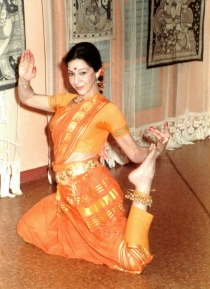
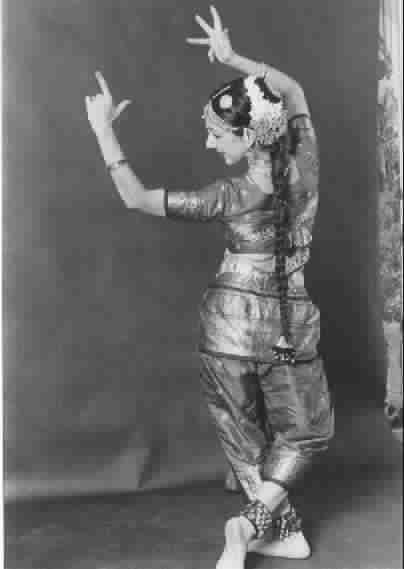
In 1985, Leda Shantala returned to Greece. She introduced the Greek public to Bharata Natyam, hitherto unknown in the country, with a series of recitals and appearances. At the same time, she longed for India, and took each and every chance to return there for months at a time, to deepen her knowledge in dance and yoga.
The Mandiram Centre
|
In the same year, she founded the “Mandiram Cultural Centre”, an innovative institution of multi-cultural character. It is there that Leda, for almost twenty years, put into practice her rich experience and knowledge through Bharata Natyam and yoga lessons as well as dance therapy sessions, bridging modern knowledge and Western scientific methods with the healing and spiritual traditions of ancient cultures.
The Mandiram Centre is, home to the only professional school of Indian dance (practice and theory) in Greece.
Since November 2003, all activities of the Mandiram Centre have shifted to the new Shantom House of Culture..
|
The Dance Theatre
In 1987, Leda founded the “Leda Shantala Dance Theatre”, through which she
translates her inter-cultural research into performances.
The Dance Theatre has presented until now 13 productions in Greece and abroad, collaborating with notable Greek and foreign artists such as Yannis Tsarouchis, Smaro Stefanidou, directors Roula Pateraki, Nikos Sakalidis, Vassilis Nikolaidis, Takis Manolopoulos, choreographers V.P. Dhananjayan, Smt. Kalaidhi Narayanan, Nirupama Nityanandan, composers Ross Daly, T.K. Padmanabhan, Adyar Lakshman, Reji George, as well as numerous Greek and Indian musicians and dancers.
As Leda grew more confident of her craft and her inspiration, performances of pure classical Indian dance gradually gave their way to composite shows, where Bharata Natyam coexists (without mixing or adulteration) with modern dance, while Leda herself is more and more recognized as a proficient actress as well as dancer.
Leda never cut off her relationship with the roots of Bharata Natyam, and until recently, whenever the school was closed, she left for India, where she renewed and enriched her knowledge and collaborated with her ex-teachers for the choreographies and the music to be used in her performances. Collaborations Leda Shantala has danced, taught, given lectures, seminars in several different venues:
• in Greece: Mandiram Centre, Hellenic-American College, Panteion University, Aegean University, International Theatre Centre of Delphi, Shantom House of Culture etc.
• in France: «Les amis de Font d’ Iziere», «Centre Mandapa»
• in India: «Abhinayia Sudha» and « Bharat Kalachar » (Chennai), «Indira Gandhi National Centre for the Arts» (N. Delhi) and «Sadhana Kendra» (Rishikesh)As a choreographer, she has worked on ancient drama performances such as “Hippolytus” (National Theatre, in Epidaurus) and Y. Tsarouhis highly acclaimed rendition of “The Trojan Women” (International Meetings of Ancient Drama, Delphi, 1985)
Theoretical research
For the past 15 years Leda Shantala's theoretical research has been focused on the following subjects, presented in papers and lectures.
1- ANCIENT RELATIONSHIP OF "MUSIKE", THE GREEK ART FORM OF THE MUSES, WITH THE INDIAN CLASSICAL ART FORM OF BHARATA NATYAM.
The ancient Greek art form of the muses called "musike", "music", consisting of dance, music, theatre and poetry, presents profound similarities with the Sanscrit art form of natya.
According to Plato, the muse Terpsichore could express any idea with the art of hand gestures. This art, "cheironomia", which in Greek means "the law of hands", was an elaborate alphabet of gestures, similar to classic Indian "hastas" and "hudras": an art gradually lost with the rise of Christianity in Greece, though some elements survive in the theatrical practice of tragedy performances.
2. ANCIENT ROOTS OF DANCE MOVEMENT THERAPY IN INDIA AND GREECE
A comparative approach to the ancient Greek art form, the art of "musike", and the Indian classical dance Bharata Natyam".
Both these arts, because of their holistic approach, are offered today as paradigms of an art that respects and honors the evolutionary process of the human being searching through all the activities of life to discover and experience the core of his or her existence. Belonging by their nature to the field of arts, as well as to the field of f healing, although ancient, they include very modern ideas about the nature of art as a therapeutic mode and means of self-knowledge.
Shantom
In November 2003 was inaugurated Shantom, the Smaro Stefanidou-Leda Shantala House of Culture, a life dream, a multicultural centre that could house all of her activities and those of others who share the same view of life and art. It is a new three-storey modern building, in the green Halandri suburb, whose architecture allows multiple uses.
It has three studios of which the biggest, on the ground floor, is especially conceived so that it can also be used as a theatre (for drama, dance and music performances), a lecture/ seminar/ convention/ exhibition/ cinema hall (for the projection of slides, films and video art).
Currently Shantom hosts courses in yoga, Indian dance, dance movement therapy by Leda Shantala, alongside courses by other teachers, in many kinds of dance, martial arts, as well as alternative therapies seminars
There is also room for massage and alternative healing therapies sessions. Its goal is to become a centre of instruction, entertainment, meeting and communication of trans-cultural scope, in a framework that respects human beings and promotes the growth of their potential.
Conclusion
To those who wonder how she can combine theatre with yoga, performing arts with a spiritual path, she answers that for her they are both ingredients of the same path and have the same goal
“What gives me life is art and creation.
Art helps me learn about myself and go where I want to”
THE END (for now)
|